to top
10 October 2026 (Saturday)
Hong Kong Time: 9 am – 11 am
* This event will be conducted in Chinese (Mandarin) on Zoom Webinar, with English and Chinese captions available.
This year’s Fellowship Talk (the “Talk”) will feature three J. S. Lee Memorial Fellows, who will share their exchange experiences as well as their work in digital research and practice. The discussion will focus on the application of digital technologies in museum collection research, data management, digital preservation, knowledge dissemination, and curatorial practice, exploring how digital transformation is creating new research methodologies and interpretive perspectives for museum professionals.
Against the backdrop of cultural institutions worldwide actively advancing digital development, this Talk aims to foster cross-regional and interdisciplinary exchange, encouraging participants to reflect on how digital technologies can enhance the preservation and dissemination of cultural heritage while deepening public understanding and appreciation of Chinese art and culture.
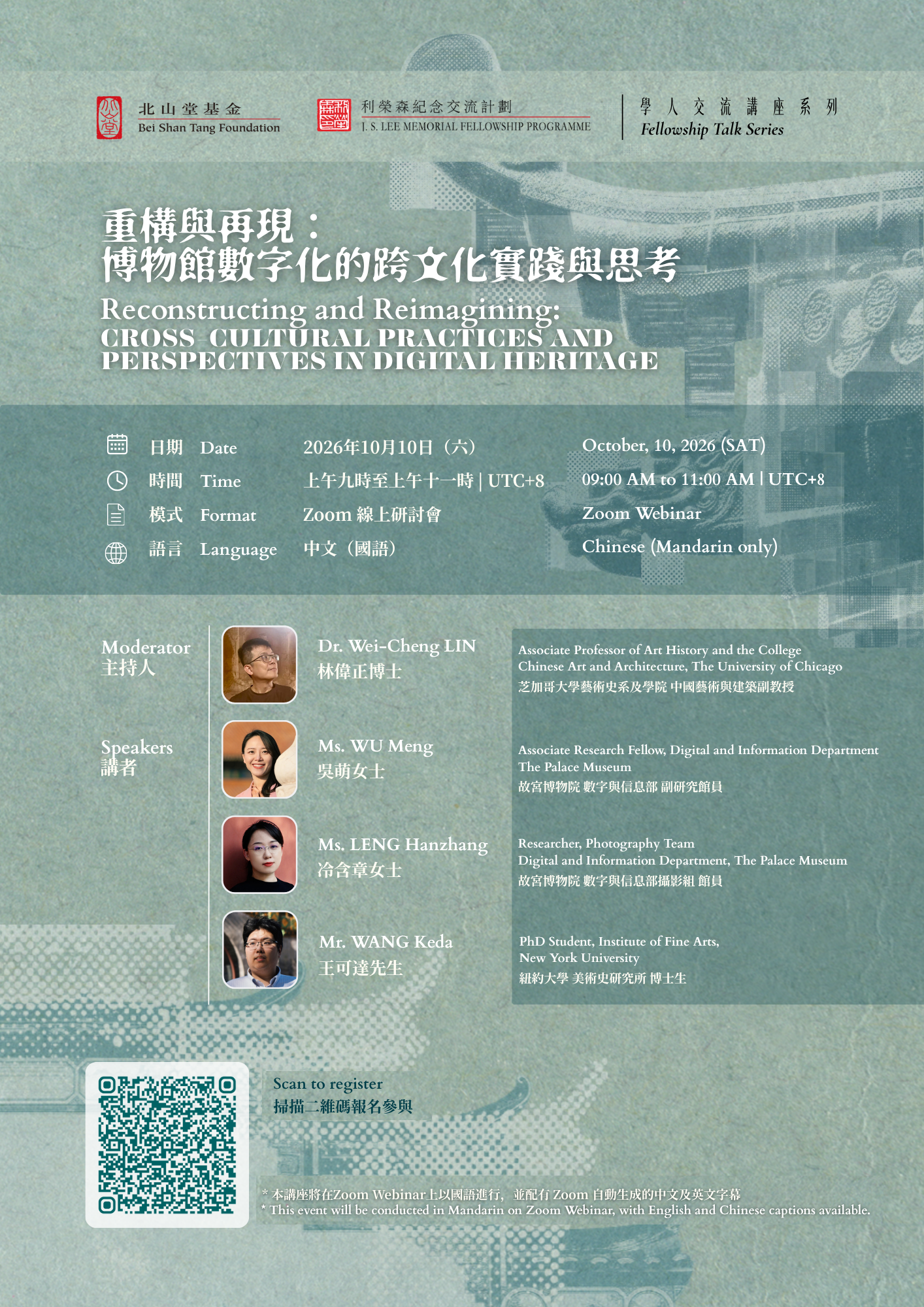
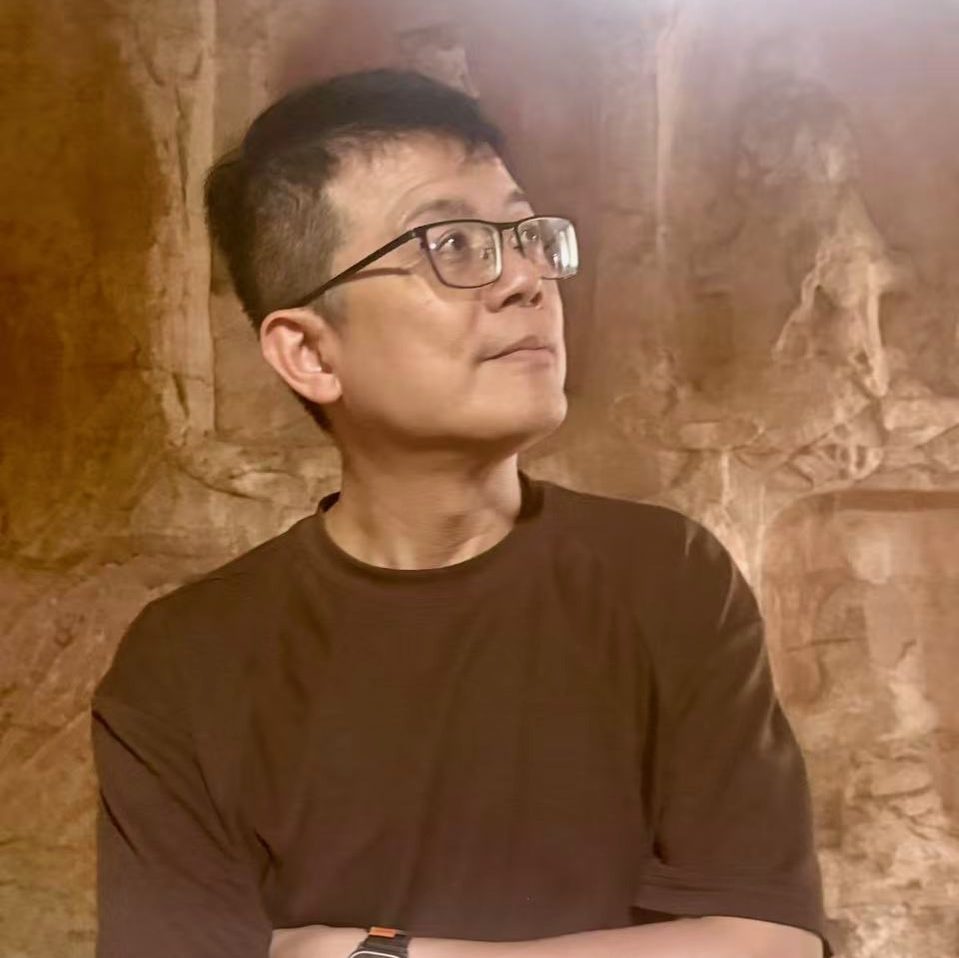
Dr. Wei-cheng LIN (Moderator)
Associate Professor of Art History and the College | Chinese Art and Architecture
The University of Chicago
Dr. Wei-Cheng Lin specializes in the history of Chinese art and architecture with a focus on medieval periods. His primary research interests concern issues of visual and material culture in Buddhist art and architecture and China’s funerary practice through history. He is the author of Building a Sacred Mountain: The Buddhist Architecture of China’s Mount Wutai (University of Washington Press, 2014). He has additionally published on a variety of topics, including collecting history, photography and architecture, the historiography of Chinese architectural history, and contemporary Chinese art. Lin is on the steering committee of the Center for the Art of East Asia and has worked closely with the UChicago Center in Beijing for art exhibitions, conferences, and publications. Lin is the Faculty Director for the Dispersed Chinese Art Digitization Project (DCADP), a digital humanities initiative supported by the Cyrus Tang Foundation. In addition to the digital projects, Lin also manages the DCADP publication series, including Exhibiting East Asian Art in a Global Context (co-edited with Chelsea Foxwell, published Jan 2026), Beijing Zhihua Temple (forthcoming later 2026), and Restoring the Fragments: A Revisit to the Longmen Grottos and Digital Reconstruction of Binyang Central Cave (forthcoming later 2026). He is also the curatorial consultant of the exhibition “Fragmented yet Connected: Paths to Wisdom at the Zhihua Temple” at the UChicago campus in Hong Kong.
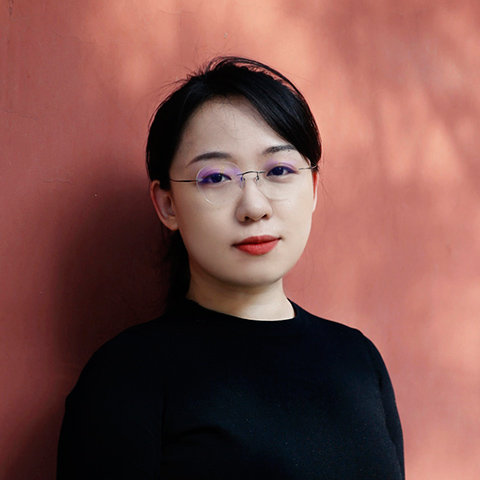
Ms. LENG Hanzhang (Speaker)
Researcher, Photography Team, Digital and Information Department | The Palace Museum, Beijing
2021/2022 J. S. Lee Memorial Fellow
Ms. LENG Hanzhang was a 2021/2022 J. S. Lee Memorial Fellow. From 2023 to 2024, she undertook a six-month exchange at the Tokyo National Museum in Japan. Through her participation in the “e-Museum” project, she studied the underlying high-definition digital image resources within a mature legal framework, with a particular focus on the full process of developing, integrating, and utilizing image resources for painting and calligraphy collections, as well as the scope and philosophy of open access.
Ms. Leng graduated from the School of Photography at the Beijing Film Academy. She is currently a Researcher and collection photographer at the Digital and Information Department of the Palace Museum. Since 2018, she has been responsible for the planning and operation of “Painting Masterpieces in the Palace Museum Collection” (故宮名畫記), a high-definition image display platform for ancient Chinese painting and calligraphy in the Palace Museum collection. Her current research focuses on the acquisition, use, presentation, and platform development of high-definition images of ancient painting and calligraphy for scholarly research. She has participated in a Key Program under the Arts Project of National Social Science Fund of China, “The Valuation and Conservation of Paintings and Calligraphies from the Jin, Tang, Song, and Yuan Dynasties.”
“Digital Practices in Japan’s Public Museums and Cultural Heritage Institutions: A Multi-Institutional Study Centered on the Tokyo National Museum“
Drawing on her fellowship at the Tokyo National Museum from September 2023 to April 2024, together with visits to several other cultural heritage institutions in Japan, Ms. Leng’s presentation will examine their institutional operations, digital projects, and practices. It will cover the organization and operation of the National Institutes for Cultural Heritage; digital resource platforms such as e-Museum and ColBase; and practices at museums and research institutes involving collection photography and image management, preservation of historical photographic materials, database development, WebGIS applications, disaster preparedness for cultural properties, and multilingual services.
By exploring issues surrounding cultural property protection and copyright, Ms. Leng will review how these cases approach the accumulation of source materials, long-term preservation, sustained use, and inter-institutional collaboration. With related work at the Palace Museum as a point of reference, her presentation will discuss how the principles guiding museum digitization are translated into specific approaches, as well as the relationships among those principles, implementation choices, and practical outcomes.
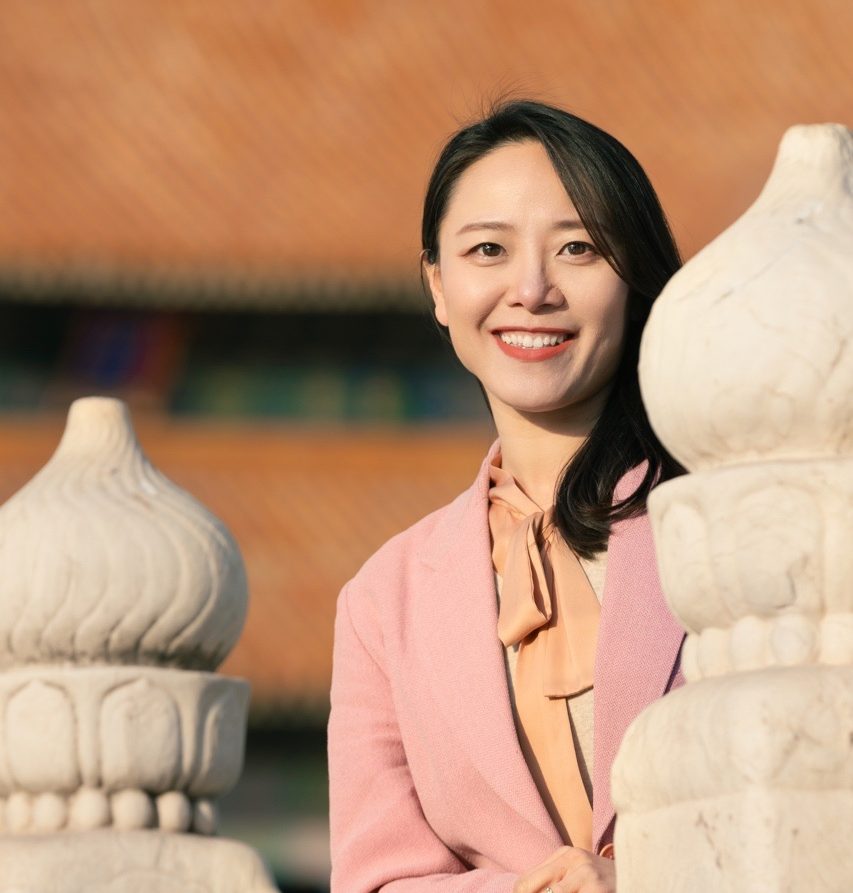
Ms. WU Meng (Speaker)
Associate Research Fellow, Digital and Information Department | The Palace Museum, Beijing
2017/2018 J. S. Lee Memorial Fellow
Ms. WU Meng is an Associate Research Fellow in the Digital and Information Department of the Palace Museum and a 2017/2018 J. S. Lee Memorial Fellow. She has long been engaged in digital curation and museum digitisation, and is committed to revitalising exhibition narratives and the interpretation of collections through new technologies and diverse media formats. In 2018, she spent four months at the British Museum in London, where she drew on her experience in the interpretation, curation and promotion of digital exhibitions at the Palace Museum to exchange ideas and practices in museum digital services, social media and audience research. She also participated in the planning and design of the British Museum’s Chinese-language social media, Chinese website, and digital services for its Gallery of China and Sir Percival David Ceramics Gallery.
A graduate of the College of Engineering and Computer Science at Wright State University in the United States, Ms. WU has curated the Digital Gallery at the Gate of Correct Demeanor (Duanmen) and the Digital Gallery in the Great Hall of Exalted Mystery (Dagaoxuan dian) at the Palace Museum. Among her projects, Discovering the Hall of Mental Cultivation: A Digital Experience Exhibition received the Gold Award in the digital interactive installation category at the F@IMP Festival, run by the International Committee for Audiovisual and New Technologies of the International Council of Museums (ICOM AVICOM), as well as the “Technical Innovation Award” for Digital Heritage Best Practice from the International Committee for Documentation of Cultural Heritage (CIPA-ICOMOS-ISPRS). She has also played a key role in leading a national cultural and tourism science and technology innovation project and has participated in national key research and development programmes. As a J. S. Lee Memorial Fellow, she visited the British Museum, the Smithsonian Institution and other organisations for knowledge exchange in museum digitisation.
“Knowledge Base and Museum Digital Exhibitions”
The rapid development and pervasive integration of digital technologies have profoundly transformed the cultural heritage and museum sectors, particularly in the field of digital exhibitions. Digital resources have become a critical foundation for reshaping not only the relationship between museums and their audiences, but also the interactions among technology, objects, and people. This presentation reviews current trends and emerging opportunities in digital exhibitions, examining how the continuous accumulation of digital resources is driving a transition from one-way participation to collaborative innovation through co-curation and crowdsourcing. In the age of artificial intelligence, generative AI is poised to further advance the construction and enrichment of museum knowledge platforms, unlocking new possibilities and inspiring new approaches to digital curation.
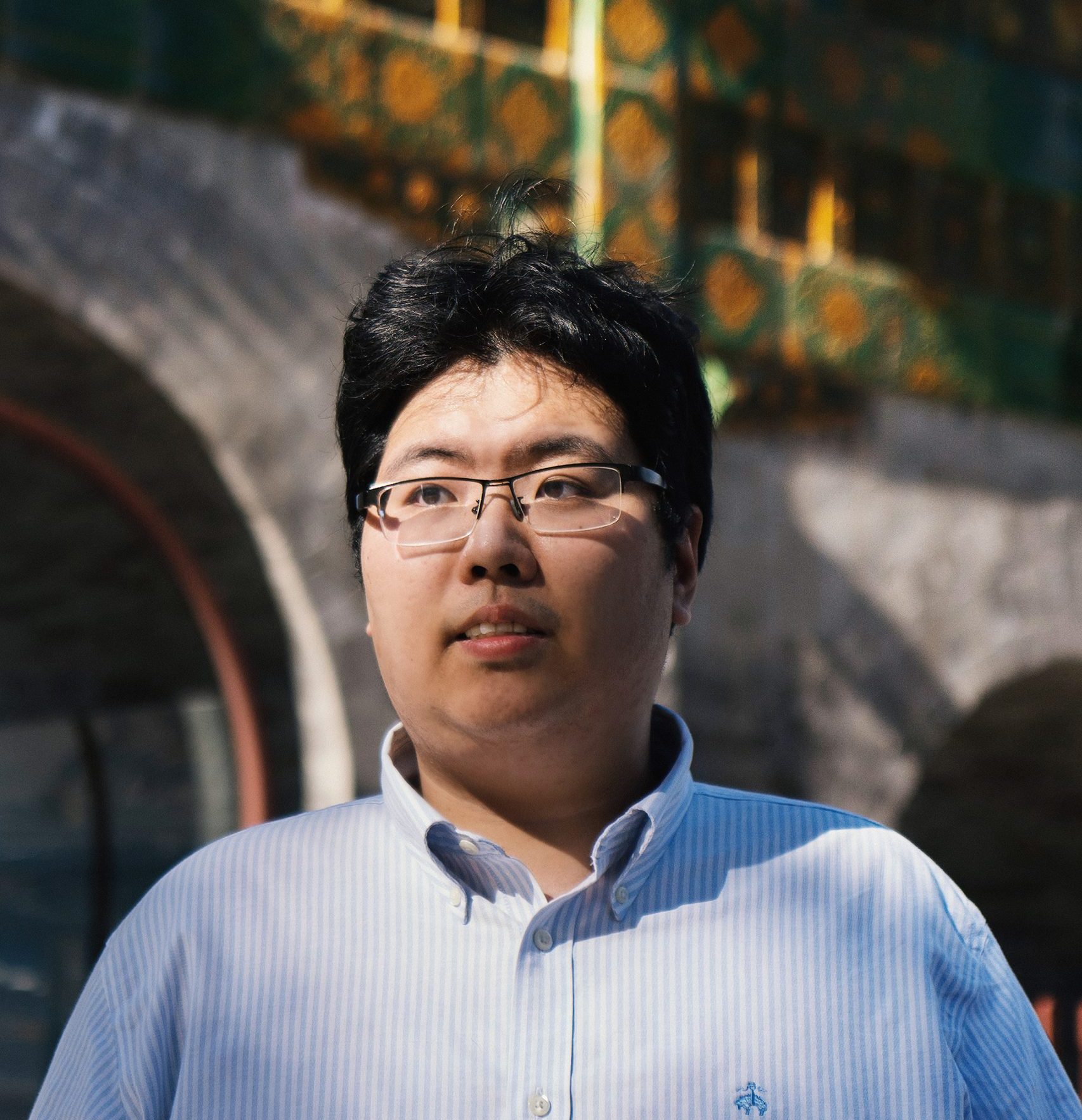
Mr. WANG Keda (Speaker)
PhD Student | Institute of Fine Arts, New York University
2025/2026 J. S. Lee Memorial Fellow
Mr. WANG Keda will spend four months at the Museum of East Asian Art Cologne (Museum für Ostasiatische Kunst Köln, “MOK”) from 2026 to 2027, exploring new approaches to the display and digitization of Chinese architectural heritage through the museum’s unique collection. As co-curator of a special exhibition marking the 50th anniversary of MOK’s Kunio Maekawa-designed pavilion in 2027, he will research architectural fragments, funerary structures, and spatial representations in paintings and screens, combining traditional curatorial methods with digital technologies such as 3D scanning and photogrammetry. The project aims to create immersive experiences for contemporary audiences and will culminate in a publication on East Asian architecture.
Mr. Wang is a doctoral candidate at the Institute of Fine Arts, New York University. An architectural archaeologist and curator specializing in East Asian built heritage, he integrates archaeological research with digital tools, including photogrammetry, 3D scanning, and virtual reality. His work bridges academic scholarship and heritage preservation, with a focus on how architecture shapes memory and human experience. He has documented more than 400 religious and funerary structures across Asia and co-founded Funes, a heritage digitization initiative.
Mr. Wang has contributed to exhibitions at the Shanghai Museum, the Arthur M. Sackler Museum at Peking University, and the award-winning exhibition Earthly Paradise at the Wu Museum (2021). He also authored and edited the accompanying exhibition catalogue and has contributed to numerous architectural publications.
“The Complete Story of Architectural Fragments: 3D Documentation, Reconstruction, and Curation of Architecture Collections”
This presentation centers on a digital heritage research project Mr. Wang conducted during his fellowship at the Museum für Ostasiatische Kunst (Museum of East Asian Art Cologne). Drawing on this project as well as his previous experience in exhibition curation and the digital documentation of architectural heritage objects, he will discuss how digital technologies can support different aspects of museum practice. The presentation will address three main dimensions:
(1) Digitisation for Curators:
Building on workflows that include 3D scanning, scale and colour calibration, model alignment, digital reconstruction, and rendering, large collections of digital models can be used to generate comparative line drawings, sectional views, exploded diagrams, structural analyses, and 3D-printed models of individual objects or object groups. These materials can further assist in testing the scale, sightlines, and spatial relationships of artefacts within exhibition spaces.
(2) Digitisation for Researchers:
Digital models provide precise information on dimensions, internal structures, and surface geometries. Different viewing angles, lighting conditions, and visualisation methods can facilitate scholarly investigation and help transform academic hypotheses into models and diagrams that can be systematically compared and evaluated. By integrating historical inventory numbers, catalogues, photographic archives, acquisition records, and multilingual literature, digitisation can also advance collection-based and archival research.
(3) Digitisation for Audiences:
Through reconstruction and visualization, architectural components preserved in museums can be repositioned from isolated “fragments” back into their original architectural contexts. This makes it possible to communicate their scale, status, craftsmanship, provenance, and connections across broader temporal and geographical frameworks. In this sense, digitisation is not merely the creation of digital surrogates; it is also a methodological approach that connects objects, research, exhibitions, and interpretation.